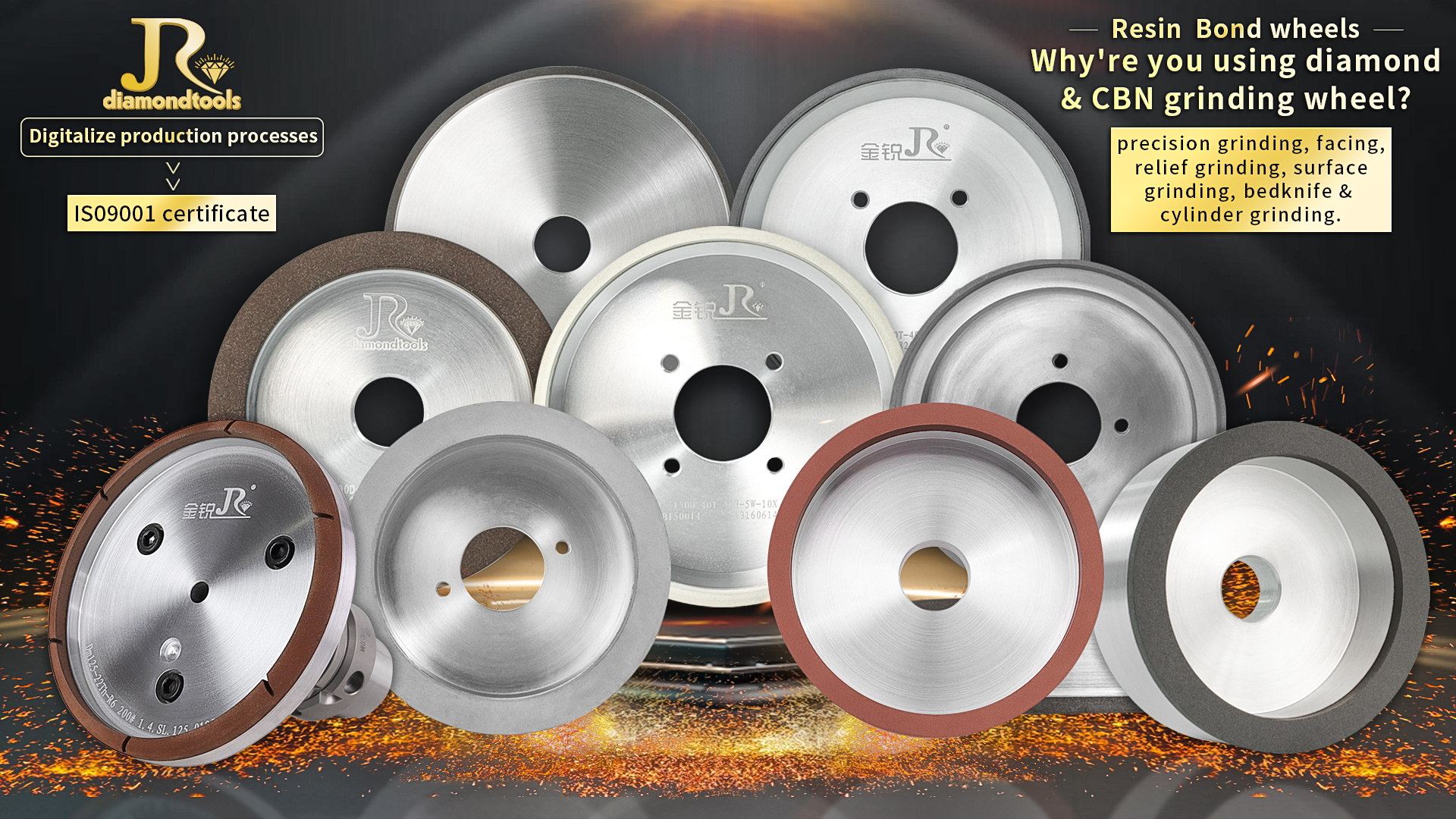
Resin bond diamond grinding wheel for cemented carbide tools
If it is necessary to minimize the grinding heat and maximize the effect of cutting, uncoated diamond can be used in the resin bond grinding wheel. Nickel-coated diamond powder can be firmly fixed in the bond and prevent them from chipping and falling off easily. Grinding with nickel-coated diamond abrasives can extend the life of the grinding wheel by 75% to 100%, but it also requires higher power consumption. Copper coating has greater thermal conductivity than nickel coating, so it is mainly used for dry grinding, during which the steel or bronze does not contact the cemented carbide. The newly developed other abrasive coatings are specially designed for certain grades of cemented carbide. For example, there are high-strength nickel-coated diamonds, which are particularly suitable for grinding steel parts with a high percentage of hard alloy materials. When grinding 100% cemented carbide, another nickel-coated diamond has better performance and efficiency. Diamond grinding wheels with different diamond crystals in the nickel coating can obtain different properties.
Filling of resin bond diamond grinding wheel
Generally, if the durability and thermal conductivity of a diamond grinding wheel are given priority, it is most effective to use a resin binder with metal filler. If the application requires maintaining, like grinding sharp corners, polyimide resin bonds are particularly suitable for such situations. In order to achieve maximum efficiency, several factors should be considered when selecting and using resin-bonded diamond grinding wheels for grinding cemented carbides, including filler, diamond type, linear speed, feed rate and grinding wheel size. It is to achieve a balance between productivity and abrasive cost. Fillers can be improved the performance of the binder, so that the efficiency can be improved when grinding cemented carbide under different conditions, and also can improve the characteristics of diamond grinding wheels. Silicon carbide, aluminum oxide, boron carbide, steel and nickel both can be used as fillers. The type, size and quantity in the bonded structure determine the performance of the grinding wheel. For example, a disc-shaped diamond wheel is used to wet-grind a cemented carbide saw blade. When the diamond wheel is in contact with the welded cemented carbide saw blade, the adhesive can be used to deal with frequent vibrations. When dry grinding cemented carbide tools with a bowl-shaped diamond wheel, a resin binder can combine internal lubrication and excellent thermal conductivity. Solid lubricants such as silver, copper or graphite can do this. This improved bonding structure will greatly extend the service life of the grinding wheel.
What is superabrasive grinding in the diamond tool industry?
The working surface characteristics of vitrified diamond grinding wheel
Related Article
n1. Type of superhard material
n2. The application of superhard material